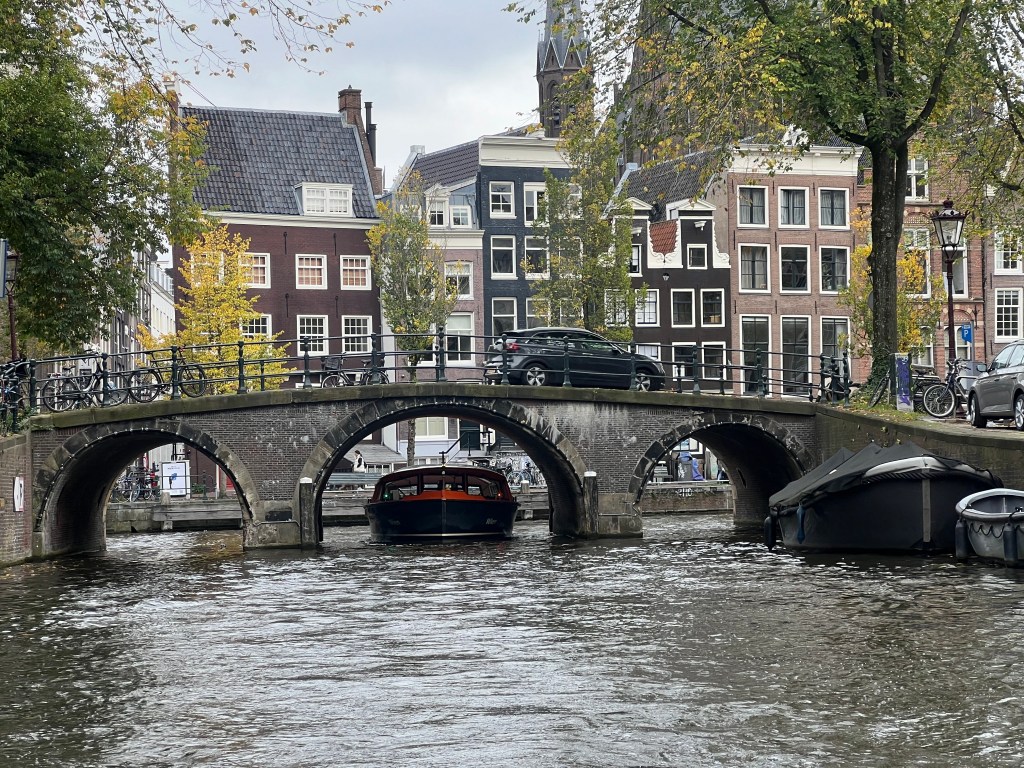
Mrs Bear and I flew into Amsterdam to begin a two week river cruise. Luckily, we chose to spend a couple days here beforehand.
I have to confess that, despite having Dutch heritage, I knew absolutely nothing about Amsterdam’s history. My first impression was to wonder why everyone goes to Venice when they could come here instead ??? Amsterdam is often referred to as the Venice of the North, and the city features an exquisite set of canals that are the cornerstone of the city’s foundation. Our guide on a two hour walk this morning said that we walked entirely on reclaimed land, built with the help of Amsterdam’s canals.

Amsterdam’s canals go back to 1250 AD. At the time, there was no city, or even local dwellers. There was a river, later to be called the Amstel, and a group of islands near the ocean. Then the locals decided to dam the river. This made the area near the headwaters a more attractive area to live. Canals were built for defense and as a flood deterrent, and land was reclaimed in between using peat and sand from the canal – building. As time passed, the locals developed formal plans for further development of the city, and Amsterdam became one of the world’s foremost trading meccas. It sat between a lot of trading partners: England and Germany to the north, Spain to the south, and Japan to the far east.

There was a heavy demand for additional housing and trading space, which led to the building of more canals and row houses for wealthy merchants.
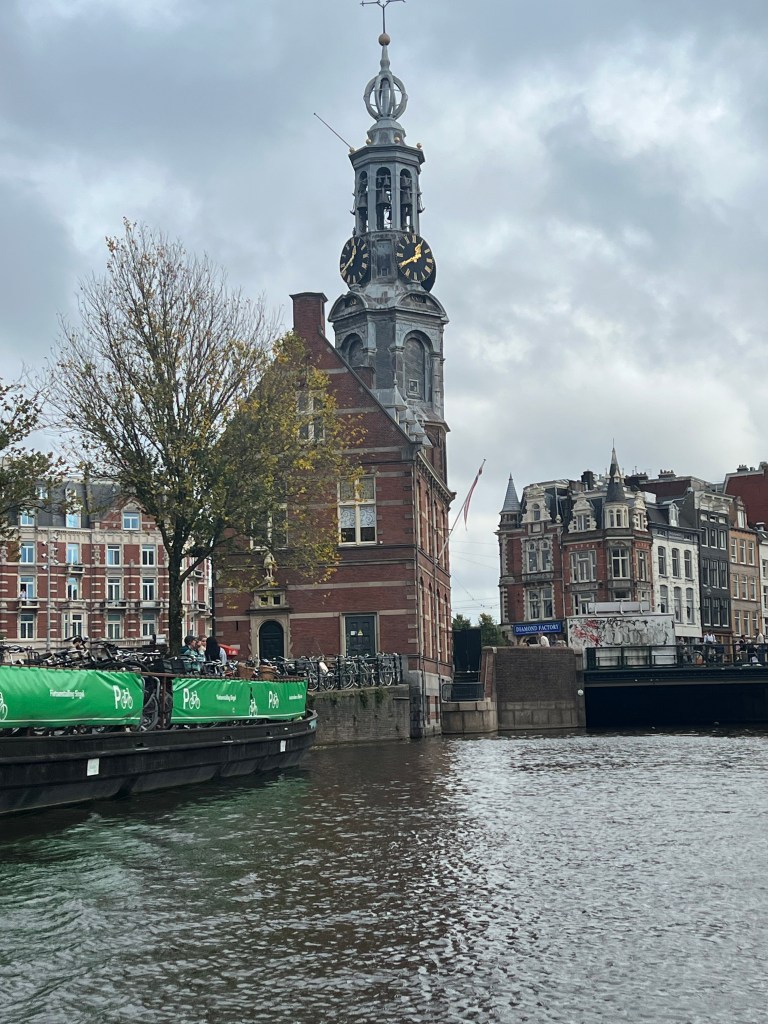

The building process was fascinating… The city leaders laid out plans for expansion that included more canals to control water levels and reclaim land. The peat and sand from the dug canals set the foundation for new land, which was entirely clay, sand, and peat. The Netherlands has no rock, so any stone used had to be imported from Germany. Canals were dug to a depth of 10 feet, and the wood used for the foundation of new houses was hammered to a depth of approximately 20 feet. These foundations held up well as long as they were not exposed to oxygen. The dug up dirt and sand became the new land.

This is a model for a new house, showing from the rear. The houses were three and four story row houses which were built adjacent to each other with no space between. They all seemed to have beautiful gardens which helped to spread the canal diggings around. Servants prepared meals and did other chores on the bottom floor, and lived in the attics. The families lived and slept on the floors in between.
Amsterdam was known as a city of tolerance and freedom … freedom of religion and culture. Today, Amsterdam is known as the most liberal city in Europe, and the people think of “liberal” as meaning free. To live your life without anyone telling you how to do it. The city has evolved into, in part, a city of Sin. Marijuana is dispensed openly and Amsterdam’s red light distinct is famous.
But nothing captures the spirit of Amsterdam better than its bicyclists. They run the city. There are over 2,000,000 bicycles in Amsterdam, and most people have two. I was looking for an appropriate picture to include and realized I don’t have one … probably because we were warned over and over about staying vigilant about their presence. The bikers ride with an aggression that suggests the road is theirs, and I, for one, liked it. They also say that about three feet of canal depth is actually old bikes thrown into the water. There are two full time boats whose job is to bring up these abandoned bikes from the depths. Finally, none of the locals wear helmets, not even the kids.

As I was writing this, I noticed two bikers on an overhead bridge … we are an hour up river from Amsterdam, but it gave me the opportunity to snap off a picture of local bikers. A good way to end this first Dutch entry.

 The Adventures of Barry Brink